
Sandwich ELISA development
Capture and detection antibody assessment, pair screening, standard strategy, signal-window evaluation, and condition optimization for protein biomarkers and antigens.
VexisBio develops and optimizes custom ELISA assays for biomarkers, antibodies, diagnostic research, and preclinical programs. We connect assay design, reagent strategy, real-matrix testing, and fit-for-purpose validation planning so the resulting data can support a clear research decision.
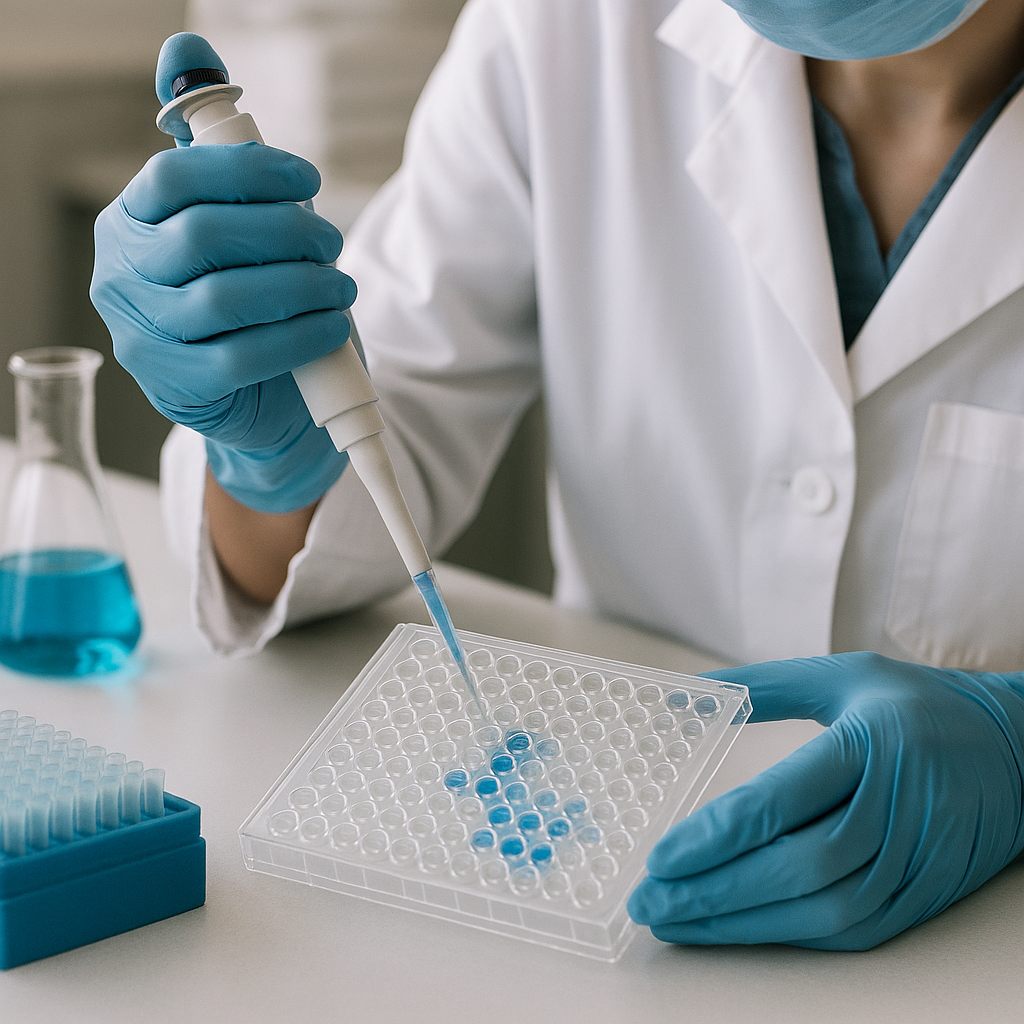
A custom assay may be the right path when a commercial kit is unavailable, existing antibodies have not been paired, the required matrix produces interference, or an early assay does not yet meet its intended sensitivity and reproducibility. We define the assay around the target, samples, decision point, and evidence required—not around a generic plate protocol.
Capture and detection antibody assessment, pair screening, standard strategy, signal-window evaluation, and condition optimization for protein biomarkers and antigens.
Format planning for small molecules, limited-epitope targets, antibodies, or other applications where a two-site sandwich format is unsuitable.
Troubleshooting of background, weak signal, narrow dynamic range, poor recovery, excessive variability, matrix effects, or dilution-dependent results.
Each scope is selected according to the starting materials and intended use. A feasibility project can answer a focused technical question, while a larger program can progress through optimization and analytical performance studies.
Staging the work reduces risk and makes the next investment decision explicit. The exact phases, turnaround, and acceptance criteria are defined in the project scope.
| Phase | Typical work | Decision or deliverable |
|---|---|---|
| 1. Technical review | Review target biology, intended use, reagents, sample matrix, expected range, sample volume, and performance needs. | Recommended assay format and written project scope. |
| 2. Feasibility | Assess critical reagents, signal over background, candidate antibody pairs, initial standard curve, and representative matrix behavior. | Feasibility data and a go, revise, or stop recommendation. |
| 3. Optimization | Refine reagent concentrations, buffers, timing, dilution conditions, dynamic range, controls, and plate workflow. | Draft optimized method and preliminary performance summary. |
| 4. Performance evaluation | Conduct agreed fit-for-purpose studies such as precision, recovery, dilutional linearity, sensitivity, specificity, and matrix comparison. | Method, data package, limitations, and recommended next steps. |
If some details are unknown, send what is available. We can begin with a technical review and identify the most important feasibility question.
Deliverables are matched to the contracted scope; clinical, diagnostic, GLP, or regulated validation is not implied unless specifically agreed.
Our San Diego team connects custom ELISA development with the upstream reagents and downstream evidence that determine whether an assay becomes useful.
ELISA development can be coordinated with recombinant protein expression and purification, antigen strategy, standards, controls, and antibody qualification.
We consider matrix effects, expected biological range, sample limitations, and the decision the biomarker data must support.
Results are organized into a practical method and scientific narrative for internal review, partner discussion, or the next development phase.
It is useful when no suitable commercial kit exists, available antibodies have not been paired, a target must be measured in a difficult matrix, or an existing assay needs better sensitivity, precision, recovery, or reproducibility.
Projects may include serum, plasma, cerebrospinal fluid, cell-culture supernatant, tissue lysate, and other research matrices. Feasibility and sample-volume requirements are reviewed for each target and matrix.
Yes. A project can begin with customer-provided reagents, commercially available reagents, or a plan to develop recombinant standards and assay-ready materials. Reagent suitability is assessed during scoping and feasibility work.
VexisBio provides research-use assay development and fit-for-purpose analytical planning. Diagnostic, clinical, GLP, or regulated validation requirements must be defined and contracted separately.
VexisBio is located in San Diego, California, and works with local and nationwide biotechnology, diagnostic, academic, and research teams. Send the target, matrix, available reagents, sample count, and intended use for an initial scope review.